Key Points
-
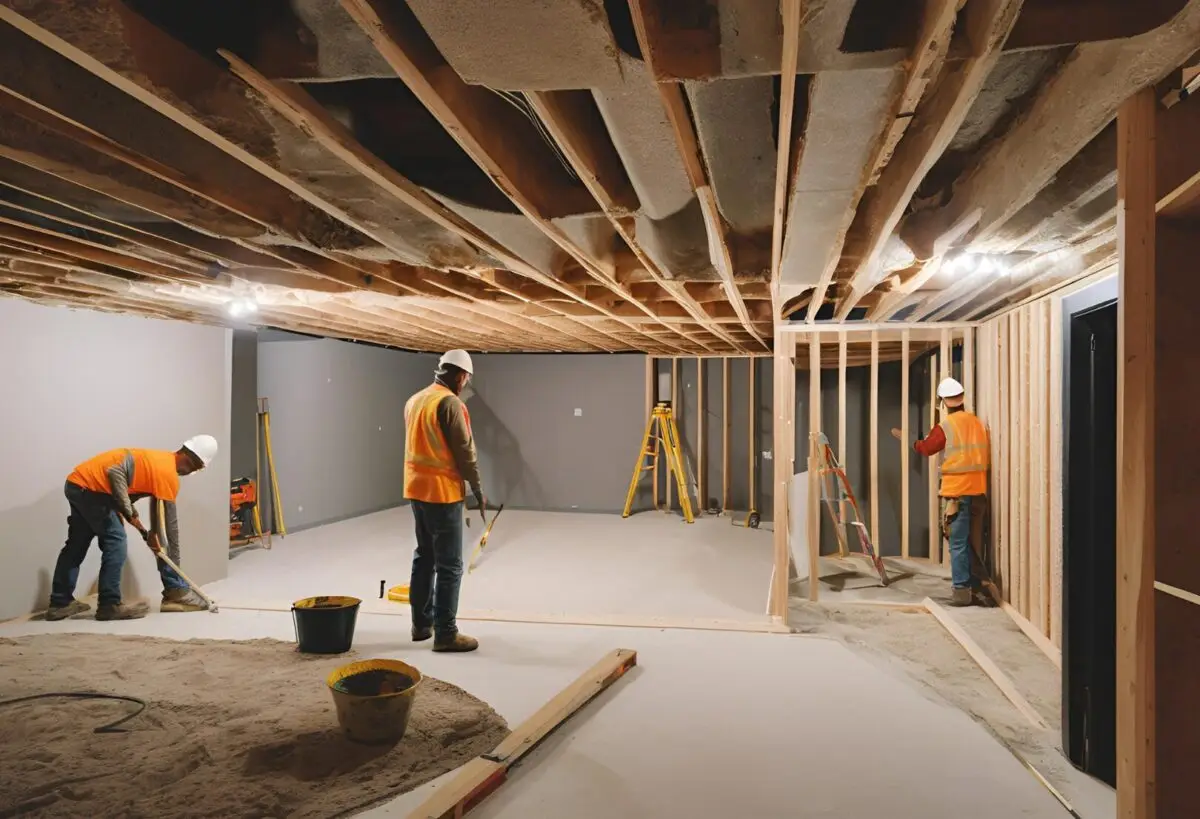
- Check moisture and egress before you spend money on finishes.
- Finishing a basement is permitted work, with inspections along the way.
- Rigid foam against concrete is the preferred insulation, not fiberglass batts.
- Decide how you will use the space first, because the use drives the layout, egress, and cost.
Introduction
Basement finishing in Idaho Falls turns unused space into living space, but the order of the work matters. Fix moisture first, confirm egress and ceiling height, and then build. Skipping that order is how a finished basement ends up with mold, a failed inspection, or a bedroom that is not legal to sleep in.
Most homeowners start with the fun part: a family room, a guest suite, a home office. Those are all good reasons to finish a basement. The checks that come first are less exciting, but they protect everything you build on top.
This guide covers ideas, the steps in order, moisture and egress basics, how finishing compares to other options, and what to know about cost.
What Is Basement Finishing in Idaho Falls?
Basement finishing is the process of turning an unfinished basement into code-compliant living space. It typically includes framing, insulation, electrical, drywall, flooring, lighting, and finishes, and sometimes a bathroom or egress window.
The goal is more usable square footage without the cost and disruption of an addition. At Blue Collar Builders, we handle basement finishing in Idaho Falls and Bonneville County from first consultation through the final walkthrough.
Basement Finishing Ideas: How Will You Use the Space?
Start with how you will use the space, because that decides the layout and what the code requires. A bedroom needs egress. A home theater needs wiring and sound control. A gym needs ceiling height.
Family Room or Home Theater
A basement is a natural fit for a family room or media space. It is separated from the main floor, so noise and light stay contained. Plan outlets, lighting, and wiring early, before drywall goes up.
Guest Suite or Bedroom
A guest suite is a popular choice, and it carries the most requirements. Any basement bedroom needs an egress window or door. Many homeowners add a bathroom as well. Basement space can also be used for visitors or potential rental income, but local rules apply.
Home Office, Gym, or Game Room
These rooms are flexible and work well in a dry basement with good lighting. Check ceiling height before you plan equipment or a tall setup, and think about sound if the room sits under a living area.
Basement Finishing Steps: How It Works
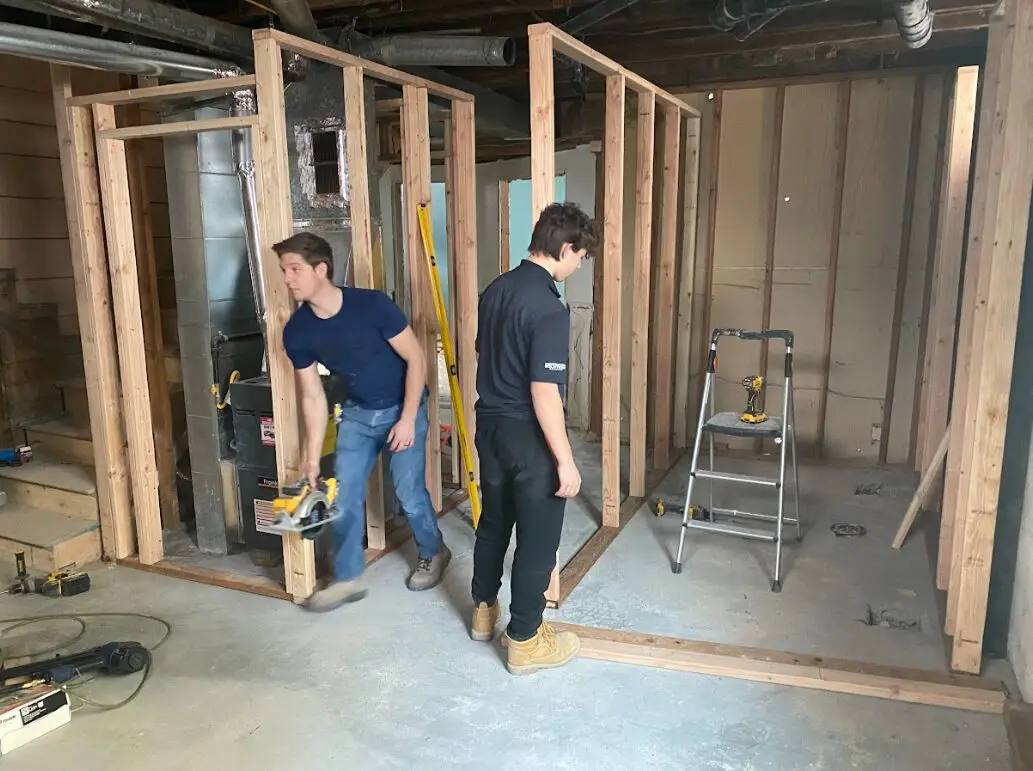
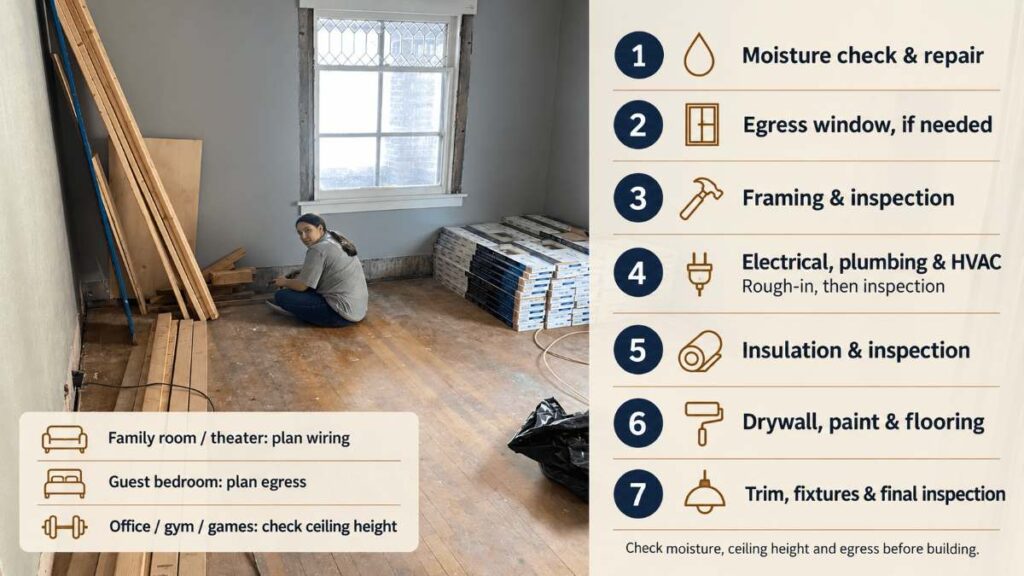
Finishing a basement follows a set order, and each step sets up the next. According to Projul’s basement finishing guide, the sequence runs through moisture remediation, egress window installation, framing, rough-in work, insulation, drywall, flooring, trim, and a final inspection.
-
- Moisture check and repair: Test and fix any water problems first.
- Egress window (if needed): Best done early, since it affects framing.
- Framing and inspection: Walls go up and are inspected.
- Electrical, plumbing, and HVAC rough-in, then inspection: Work behind the walls is checked before it is covered.
- Insulation and inspection: Walls are insulated and checked.
- Drywall, paint, and flooring: The space starts to look finished.
- Trim, fixtures, and final inspection: Details are completed and signed off.
Blue Collar Builders follows four phases on every project: consultation, design, construction, and final touches. For a basement, the consultation and design phases are where we check moisture, ceiling height, and egress before any building starts.
Permits and inspections can add time.
Basement Waterproofing and Moisture: Check This First
Moisture is the first thing to check, because finishing over a wet basement hides the problem and makes it worse. Projul calls water flowing toward the foundation the “number one cause of wet basements,” and sometimes better grading and downspout extensions fix it without interior waterproofing.
Here is what to look at before you plan anything:
-
- Grading and downspouts: Soil should slope away from the house, and downspouts should discharge well away from the foundation.
- Humidity: Projul suggests leaving a hygrometer in the space for one to two weeks. If relative humidity stays above 60 percent, address it before finishing.
- Cracks: Hairline cracks are common. Cracks wider than 1/4 inch, or ones that show displacement, need a structural evaluation first.
- White powder on concrete: This is efflorescence, and it indicates water moving through the wall.
Options for fixing real moisture problems include exterior waterproofing, interior drain tile, crack injection, and vapor barriers.
Insulation matters here too. Projul recommends rigid foam board against concrete walls and warns against putting fiberglass batts directly against concrete.
Basement Egress, Ceiling Height, and Code Basics
Egress is a safety requirement, not an upgrade. A basement bedroom needs a way out in a fire, and finishing is permitted work with inspections along the way.
Typical code points, per Projul, include:
-
- An egress window or door for any bedroom
- A minimum ceiling height of about 7 feet in habitable spaces, with some allowance for beams and ducts
- Smoke and carbon monoxide detectors in sleeping areas and on every level
- Permits for building, electrical, plumbing, and mechanical work
These are typical figures, not Idaho Falls rules.
One Idaho Falls customer, Chaia Braithwaite, described the difference this work made: “We had barely functional and liveable spaces, and now we have rooms that are safe and comfortable.” Her project included an egress window installation.
For the full details, read our guide to Idaho basement egress window requirements.
Why Finish Your Basement? Benefits and Considerations
Finishing a basement adds usable space inside the walls you already have. For many homeowners, that is the main reason.
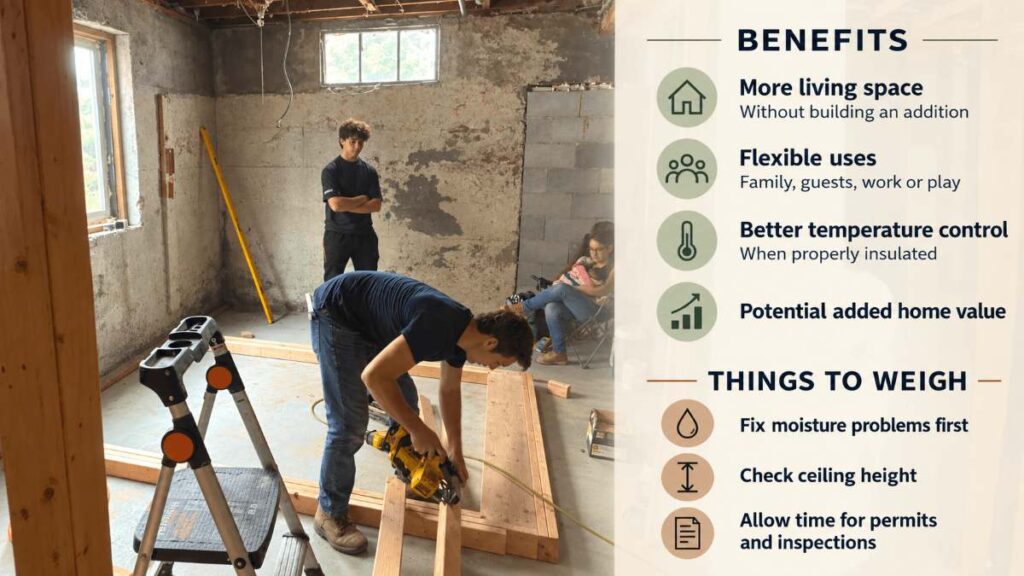
Benefits:
-
- More living space without an addition
- A flexible room for family, guests, work, or play
- Better temperature control when the space is insulated properly
- Potential value added to the home
Things to weigh:
-
- Moisture problems must be fixed first
- Low ceilings can limit how you use the space
- Permits and inspections add steps and time
Compare Options: Finished Basement vs. Home Addition vs. Moving
A finished basement usually costs less and disrupts less than an addition. Moving avoids construction but brings its own costs.
|
Option |
Space gained |
Disruption |
Best for |
|
Finished basement |
Uses existing footprint |
Moderate, indoors |
Homeowners with a dry, usable basement |
|
Home addition |
New square footage |
Higher, with exterior work |
Homeowners who need a bigger footprint |
|
Moving |
New home entirely |
Highest |
Homeowners whose needs have outgrown the house |
On cost, HomeAdvisor’s June 2026 update puts the average basement finishing cost at about $32,000, with a typical range of $15,000 to $75,000. Those are national figures, and your price will depend on size, finishes, and what the basement needs first.
Who Is Basement Finishing For?
Basement finishing fits homeowners with a dry basement, enough ceiling height, and a clear idea of how they want to use the space. If that is you, finishing is often one of the most practical ways to add room to your home.
It is not the right first step if you have active water problems or structural cracks. Those need to be fixed first, and we will tell you so at the consultation. If you need far more space than a basement can offer, an addition may be a better path.
Expert Tips for Basement Finishing in Idaho Falls
-
- Test moisture before you design. Plans built on a damp basement fail later.
- Do the egress window early. It changes framing, so it should not be an afterthought.
- Use rigid foam against concrete. Avoid fiberglass batts directly on concrete walls.
- Pull permits and plan for inspections. It protects safety and resale.
Following these steps is the safest way to approach basement finishing in Idaho Falls.
Conclusion: Basement Finishing in Idaho Falls
Basement finishing in Idaho Falls works best when you check moisture and egress first, choose the use of the space early, and plan for permits and inspections. Do those things in order, and the finished basement will be safe, comfortable, and built to last.
Ready to find out what your basement can become? Schedule a free in-home consultation with Blue Collar Builders or call 208-269-5556 for a free quote.
Frequently Asked Questions
What is basement finishing in Idaho Falls and what does it include?
Basement finishing turns an unfinished basement into code-compliant living space. It typically includes framing, insulation, electrical, drywall, flooring, and finishes, and sometimes a bathroom or egress window.
How much does it cost to finish a basement?
HomeAdvisor’s June 2026 update puts the national average at about $32,000, with a typical range of $15,000 to $75,000. Your cost depends on size, finishes, and any moisture or egress work.
Do you need a permit to finish a basement?
Generally, yes. Projul states that basement finishing is permitted work, usually covering building, electrical, plumbing, and mechanical.
Do you need an egress window in a finished basement?
Any basement bedroom needs an egress window or door under typical code. Even for non-bedroom spaces, an egress window adds safety and light.
How do you prevent moisture problems in a finished basement?
Fix grading and downspouts first, test humidity, and address cracks or leaks before building. Use rigid foam against concrete walls and avoid fiberglass batts directly on concrete.
How long does it take to finish a basement?
Permits, inspections, and any moisture or egress work can add time.
Is finishing a basement better than building an addition?
If your basement is dry and tall enough, finishing usually costs less and disrupts less than an addition. If you need a bigger footprint, an addition may be the better choice.