Key Takeaways
- The right deck design starts with how you plan to use the space, not simply how large you want it to be.
- Wood and composite decking offer different advantages in appearance, maintenance, and upfront cost.
- Idaho Falls weather, including snow, freezing temperatures, moisture, and summer sun, should be considered during design and material selection.
- Deck costs depend on more than square footage. Height, foundation work, stairs, railings, materials, site conditions, and custom features all affect the final price.
- Permits and building requirements can vary depending on the deck and property.
- A detailed estimate should explain the project’s materials, structural work, labor, and other included costs before construction begins.
Introduction
A deck can do more than add square footage to your backyard. Done well, it creates a comfortable transition between your home and the outdoors, giving you a place to grill, eat dinner, entertain friends, or enjoy a quiet morning outside.
For homeowners considering deck building in Idaho Falls, however, the planning process deserves just as much attention as the finished appearance.
Idaho Falls homes experience cold winters, snow, freezing temperatures, and warm, sunny summers. Those conditions can affect everything from material selection and drainage to structural planning and maintenance. Your home’s access to the yard, the property’s slope, and even where you want to place outdoor furniture can also influence the design.
Before choosing decking boards or comparing estimates, it helps to understand what actually goes into a deck project. Here’s what Idaho Falls homeowners should consider, from materials and costs to construction and choosing a builder.
What Should You Consider Before Building a Deck in Idaho Falls?
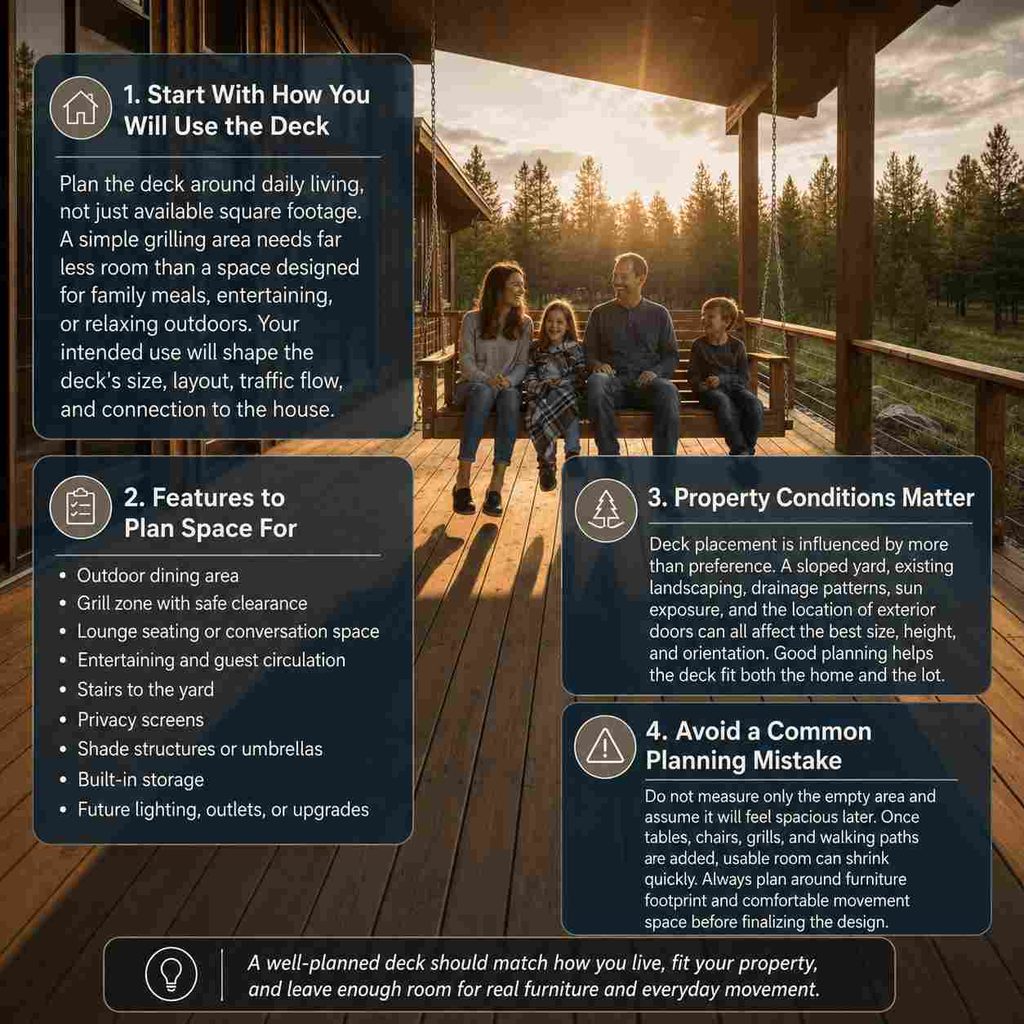
Start with how you will use the deck.
A homeowner who wants space for a grill and two chairs has very different needs from a family that regularly hosts outdoor dinners. Planning around those activities first helps determine how much space you actually need and where the deck should connect to the home.
Think about whether you need room for:
- Outdoor dining
- Grilling
- Lounge seating
- Entertaining
- Stairs to the yard
- Privacy screens
- Shade
- Storage
- Future lighting or other features
The property matters, too. A sloped yard, existing landscaping, drainage patterns, sun exposure, and the location of exterior doors can all influence the deck’s size and placement.
One simple planning mistake is measuring the empty area without considering what will eventually occupy it. A deck that looks spacious on a plan can feel crowded once a dining table, grill, chairs, and walking paths are added.
What Types of Decks Can You Build in Idaho Falls?
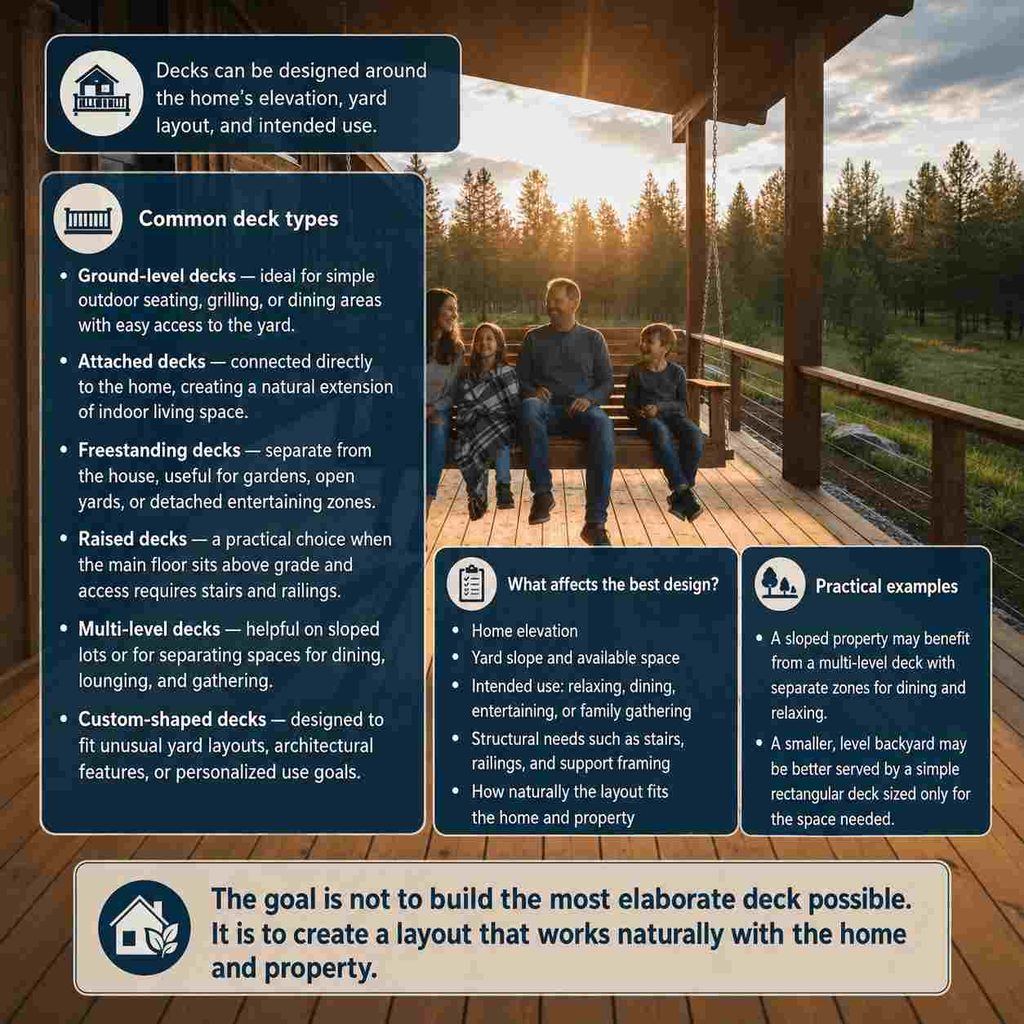
Decks can be designed around the home’s elevation, yard layout, and intended use.
A ground-level deck can work well when the goal is to create a straightforward outdoor seating or dining area. An elevated deck may make more sense when the home’s main living area sits above the yard, although height introduces additional structural, stair, and railing considerations.
Common options include:
- Ground-level decks
- Attached decks
- Freestanding decks
- Raised decks
- Multi-level decks
- Custom-shaped decks
For example, a sloped property might benefit from a multi-level design that creates separate areas for dining and relaxing. A smaller, level backyard may be better served by a simple rectangular deck that provides exactly the space the homeowner needs.
The goal is not to build the most elaborate deck possible. It is to create a layout that works naturally with the home and property.
What Deck Materials Are Best for an Idaho Falls Home?
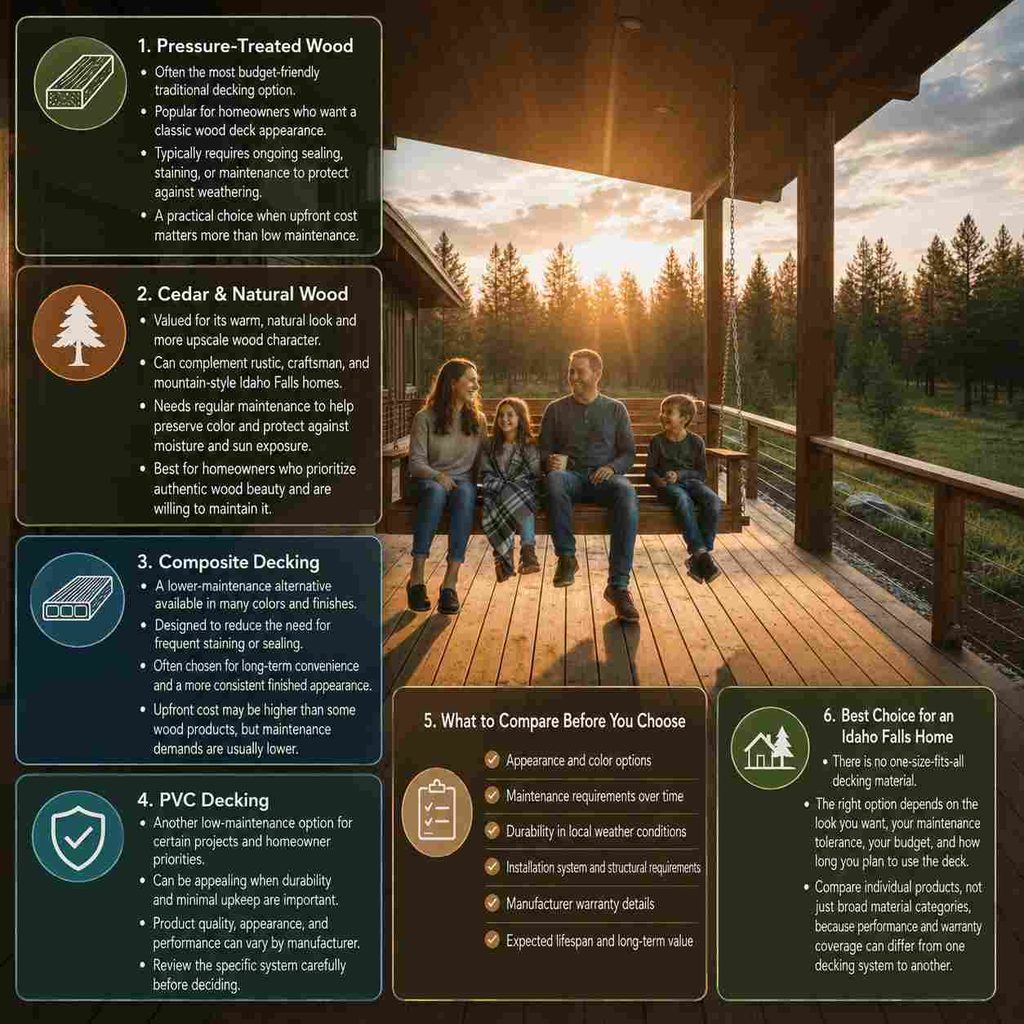
Decking material affects appearance, maintenance, durability, and upfront cost.
Pressure-treated wood is a common choice for homeowners who want a practical traditional deck. Cedar and other wood products can provide a natural appearance, while composite decking offers a lower-maintenance alternative with a wide range of colors and finishes.
PVC decking is another option for some projects, depending on the homeowner’s priorities and the product being considered.
There is no material that is automatically right for every property. Compare the products themselves, not just the broad category. Different decking systems can have different installation requirements, warranties, maintenance recommendations, and performance characteristics.
The right choice should balance the look you want with the amount of maintenance you are willing to handle and how long you expect to use the deck.
Is Wood or Composite Decking Better for an Idaho Falls Home?
Wood and composite decking each have advantages, so the better choice depends on your priorities.
Wood offers the natural appearance many homeowners prefer and can often be repaired, refinished, and maintained over time. The tradeoff is that exposed wood requires regular care to help protect it from weather and preserve its appearance.
Composite decking can reduce many of the routine maintenance demands associated with traditional wood. It can also provide a consistent appearance, although premium composite products may have a higher initial cost.
For an Idaho Falls homeowner, the decision should consider more than the price of the boards. Think about snow and sun exposure, maintenance expectations, appearance, budget, and how heavily the deck will be used.
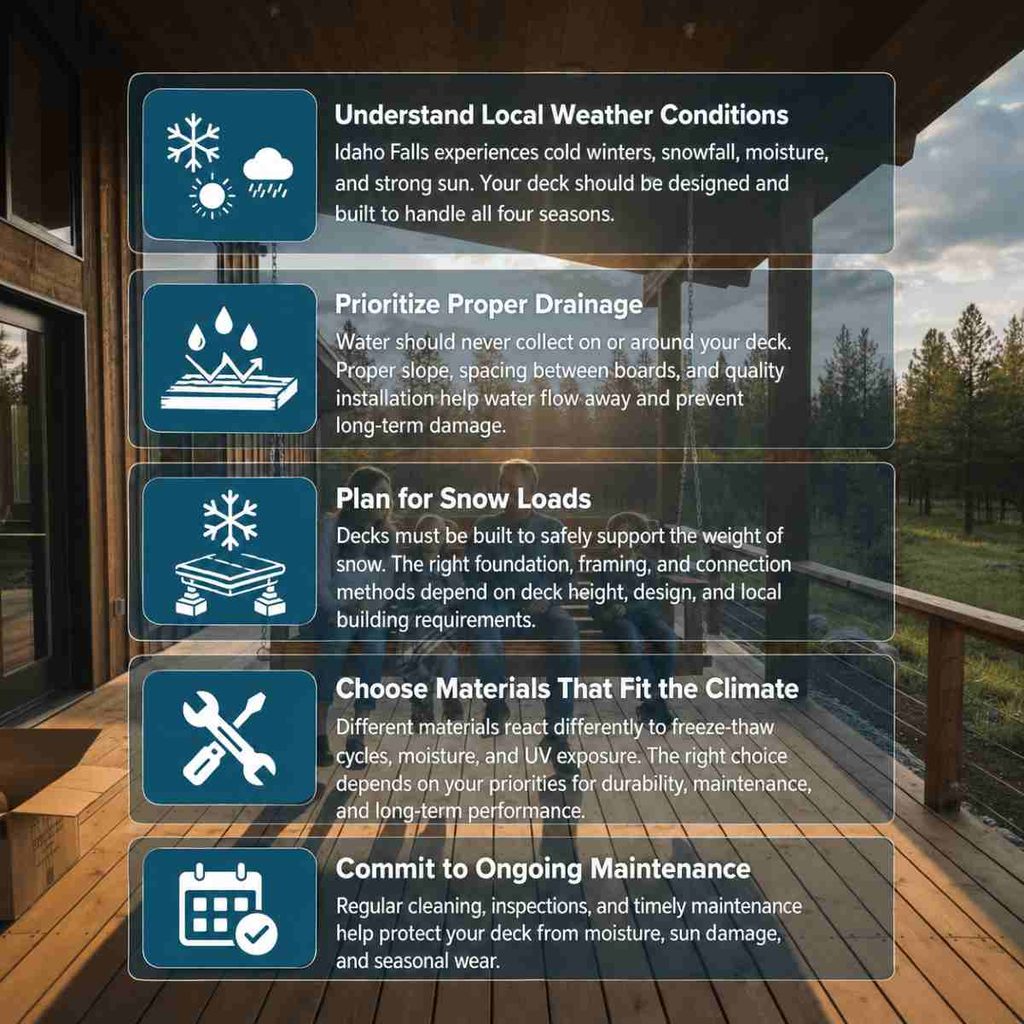
How Does Idaho Falls Weather Affect Deck Materials and Design?
Local weather should be part of the design conversation from the beginning.
Snow, freezing temperatures, moisture, and summer sun all place different demands on an outdoor structure. The goal is not to find a material that is completely unaffected by weather. Instead, the deck should be designed and installed appropriately for the conditions it will experience.
Drainage is particularly important. Water should have a way to move away from the structure instead of collecting around the deck or remaining trapped against components. Proper spacing, installation practices, and product-specific requirements can also affect how the deck handles moisture.
Snow also makes structural planning important. The appropriate foundation and framing approach depends on the deck’s design, height, site conditions, and applicable building requirements.
In other words, weather resistance is not just a material decision. Good performance comes from the combination of appropriate materials, sound construction, drainage, and ongoing maintenance.
How Much Does It Cost to Build a Deck in Idaho Falls?
Deck costs in Idaho Falls vary based on size, materials, height, foundation requirements, stairs, railings, site conditions, and design complexity. There is no single price per square foot that accurately represents every project.
Consider two decks that are both 200 square feet.
One might be a simple ground-level rectangle with straightforward access and basic materials. Another could be elevated, require substantial foundation work, include stairs and railings, use premium composite decking, and have a more complicated shape.
The square footage is identical, but the construction requirements are very different.
Other factors that can affect the cost include:
- Existing deck removal
- Site preparation
- Ground conditions
- Foundation and footings
- Framing
- Decking material
- Railings
- Stairs
- Custom features
- Permits and inspections
- Labor and site access
A project-specific estimate is therefore much more useful than a generic online cost calculator.
What Makes One Deck More Expensive Than Another?
Complexity is often what separates a basic deck from a more expensive project.
An elevated deck requires more structural planning than a simple platform. Multiple levels can require additional framing and stairs. A complicated shape may involve more cutting and installation time than a straightforward rectangle.
Custom features can also increase the scope. Built-in seating, privacy screens, upgraded railings, lighting, pergolas, or outdoor cooking areas may require additional planning and materials.
This is why homeowners should look at the complete scope of a project instead of comparing contractors solely on the final number. A lower estimate is not necessarily a better value if important work or materials are excluded.
What Permits and Building Requirements Apply to Decks in Idaho Falls?
Permit and building requirements depend on the specific deck and property.
Factors such as height, location, attachment to the home, structural design, and applicable local requirements can affect what approvals or inspections are needed.
Homeowners should verify current requirements with the City of Idaho Falls before construction begins rather than relying on an outdated rule or a generic answer found online.
A qualified builder can also help identify which requirements may apply to the project and explain how permitting fits into the construction timeline.
What Does Deck Construction in Idaho Falls Involve?
A well-built deck starts with more than installing boards.
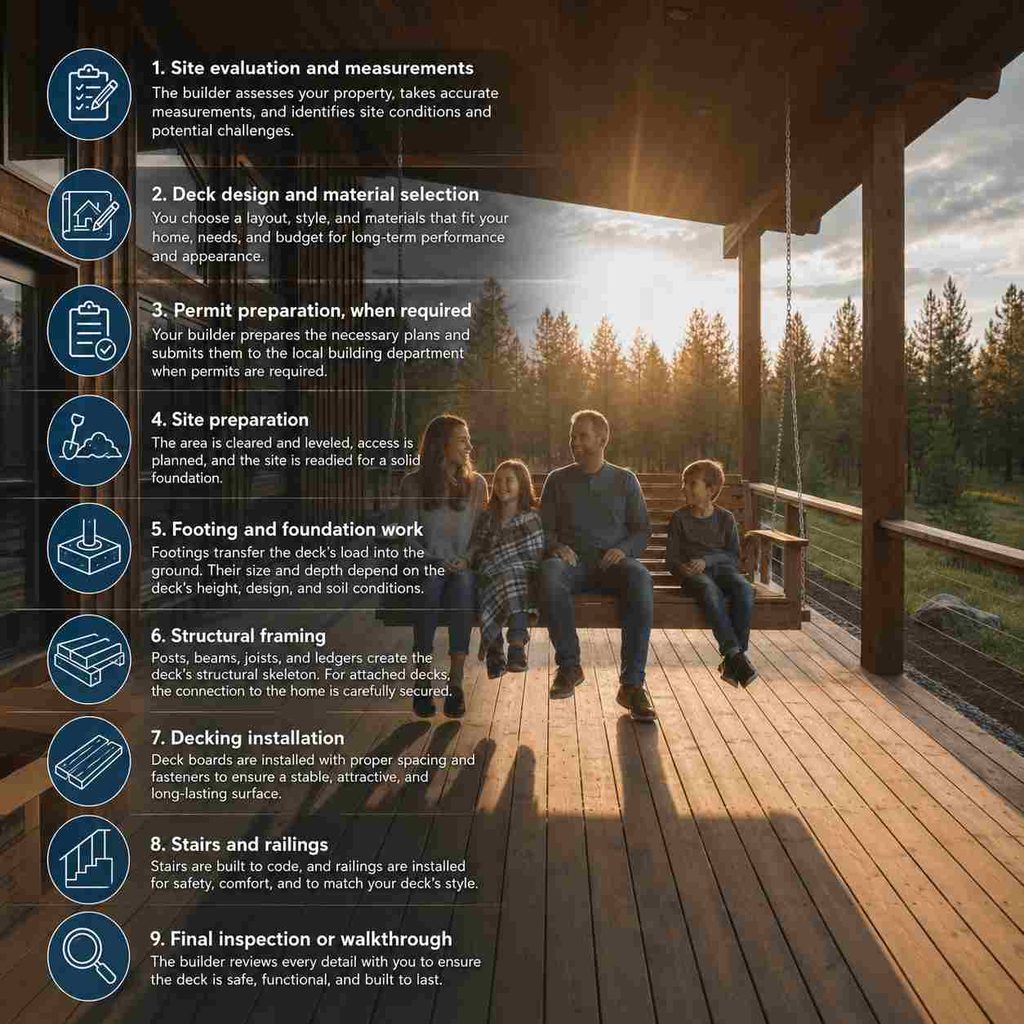
The first step is usually a site evaluation and design discussion. This is where the builder can look at the property, understand how you want to use the deck, take measurements, and identify potential challenges.
From there, the project may involve:
- Site evaluation and measurements
- Deck design and material selection
- Permit preparation, when required
- Site preparation
- Footing and foundation work
- Structural framing
- Decking installation
- Stairs and railings
- Final inspection or walkthrough
The foundation deserves particular attention because the footings transfer the deck’s load into the ground. Their design depends on factors such as the deck’s size, height, structural requirements, and site conditions.
Framing forms the structural skeleton of the deck and supports the finished decking surface. For an attached deck, the connection between the structure and the home also needs careful planning because it is an important part of the overall structure.
These details may not be visible once the deck is finished, but they are a major part of what makes the finished space safe and durable.
How Long Does It Take to Build a Deck?
A simple deck may have a relatively straightforward construction period, while a larger custom or elevated deck can take considerably longer.
The full project timeline may include design, material ordering, permitting, inspections, site preparation, and construction. Weather, material availability, site conditions, and project complexity can also affect scheduling.
If you have a particular date in mind, discuss the timeline with your builder before construction begins. It is better to understand the complete process than to focus only on how many days workers will be physically on the property.
What Could a Deck Project Look Like for an Idaho Falls Homeowner?
Imagine a homeowner with a small, level backyard who wants somewhere to grill and have dinner outside. A simple ground-level deck with enough space for a table, chairs, and grill may provide everything needed without paying for unnecessary features.
Now consider a larger family that frequently entertains. An attached deck near the kitchen could create a natural transition between indoor and outdoor living, with separate areas for dining, grilling, and relaxing.
A property with a significant change in elevation presents another situation. A raised or multi-level design may make better use of the yard, but it can also require additional foundation work, stairs, railings, and structural planning.
These examples show why there is no one-size-fits-all deck design. The property and the way you intend to use the space should drive the design.
What Should You Look for When Hiring a Deck Builder in Idaho Falls?
Look beyond the price.
A reliable contractor should be able to explain the proposed design, materials, structural work, timeline, and project scope in language you can understand.
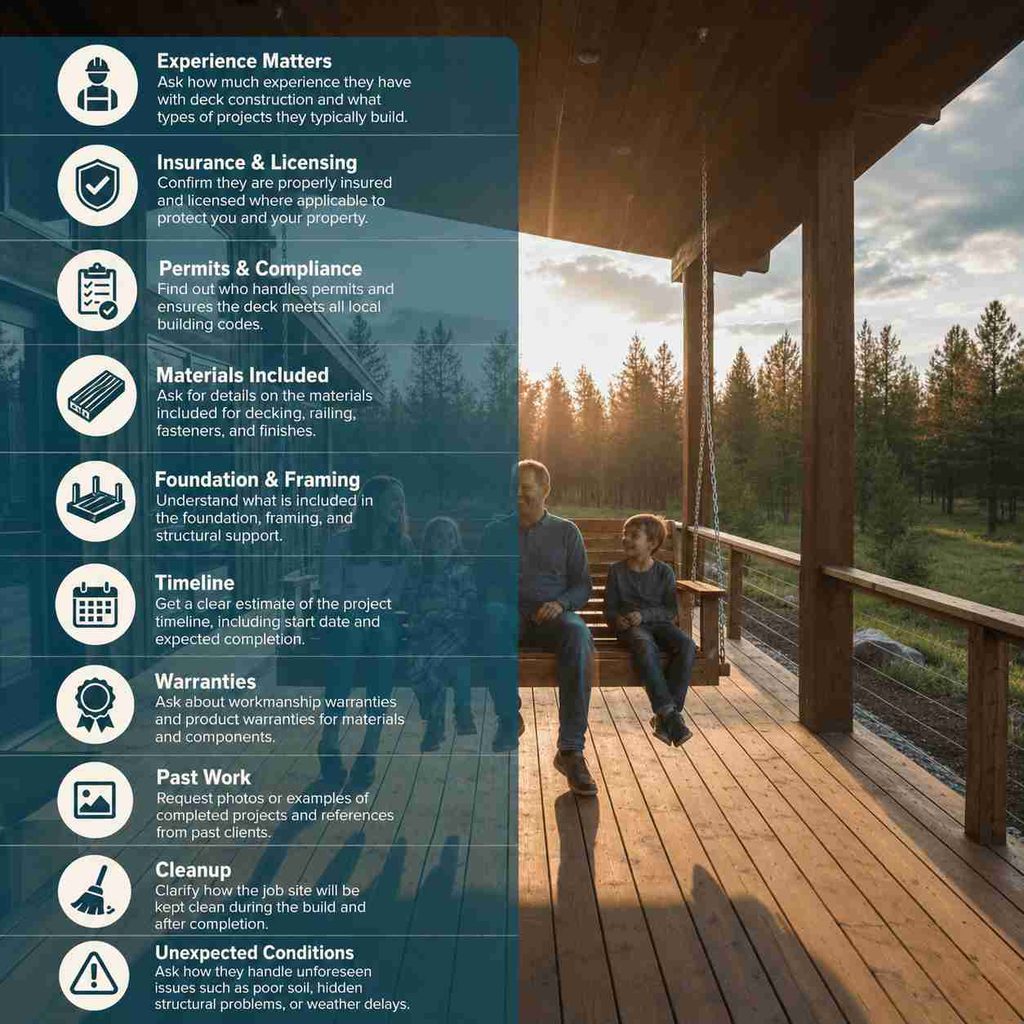
Before hiring a contractor, consider asking:
- How much experience do you have with deck construction?
- Are you properly insured and licensed where applicable?
- Who handles permits?
- What materials are included?
- What is included in the foundation and framing work?
- How long is the expected project timeline?
- What warranties are provided?
- Can you show examples of completed work?
- How is cleanup handled?
- How are unexpected site conditions handled?
You should also feel comfortable asking why a particular material or construction approach is being recommended. An experienced builder should be able to explain the reasoning instead of simply telling you what to choose.
What Should Be Included in a Deck Building Estimate?
A detailed estimate should make it clear what you are actually paying for.
Depending on the project, it may identify:
- Deck dimensions and layout
- Decking material
- Framing
- Foundation or footing work
- Stairs
- Railings
- Site preparation
- Demolition
- Permits
- Labor
- Cleanup
- Warranty information
This matters when comparing estimates.
If one contractor includes stairs, premium decking, site preparation, and cleanup while another does not, the lower number may not represent the same project.
A clear scope helps everyone understand what is included before construction starts.
How Can You Make a Deck Easier to Maintain?
Maintenance begins with choosing materials that match your expectations.
Traditional wood generally requires more ongoing care than composite decking. Wood may need cleaning, staining, sealing, or other maintenance depending on the product and exposure. Composite decking typically reduces some of that routine work, but it still needs to be cleaned and maintained according to the manufacturer’s recommendations.
Construction details matter as well. Proper drainage, appropriate spacing, and good installation practices can help reduce moisture-related problems.
It is worth thinking about maintenance before you choose your materials. A slightly different upfront investment may be worthwhile if it better matches the amount of time you want to spend caring for the deck.
What Deck Features Are Worth Considering?
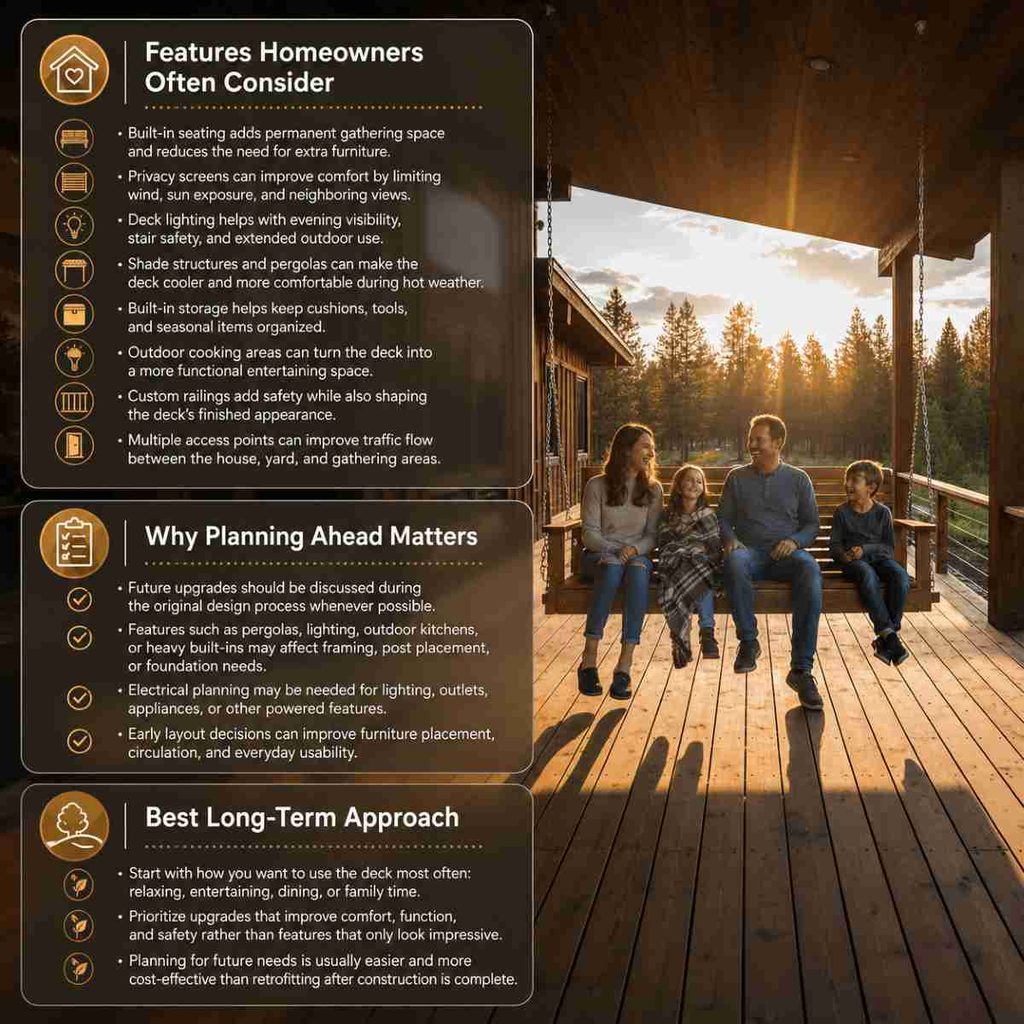
The most useful upgrades are usually the ones that make the deck more comfortable or functional.
Depending on your plans, you might consider:
- Built-in seating
- Privacy screens
- Deck lighting
- Shade structures
- Pergolas
- Built-in storage
- Outdoor cooking areas
- Custom railings
- Multiple access points
The important part is planning ahead.
If you think you may eventually want a pergola, lighting, an outdoor kitchen, or another significant feature, mention it during the original design process. Some additions can affect structural planning, electrical work, layout, or foundation requirements.
Planning for future needs can be easier than trying to retrofit them after the deck is complete.
What Are the Most Common Deck-Building Mistakes Homeowners Should Avoid?
One common mistake is choosing materials based only on the lowest initial price.
Another is underestimating the amount of space needed for actual use. A deck can look large on a drawing but feel cramped when furniture, a grill, and people are all occupying the same area.
Ignoring drainage, access, stairs, railings, foundation requirements, or local building rules can create bigger problems during construction.
Homeowners should also avoid comparing contractors based solely on the final price. Review what each proposal includes, which materials are specified, how structural work is handled, and what responsibilities fall to the homeowner.
A detailed estimate makes those differences much easier to identify.
Is Building a Deck the Right Outdoor Upgrade for Your Home?
A deck can be a worthwhile investment when it solves a real need.
If your family enjoys outdoor meals, entertaining, grilling, or simply spending time outside, a well-designed deck can make the backyard significantly more useful.
Before moving forward, consider how often you will use it, what activities need to fit comfortably, how much maintenance you are willing to handle, and how the deck will connect to the existing home.
The right deck is not necessarily the biggest or most expensive one. It is the one that fits the property, supports the way you live, and makes sense for your long-term plans.
What Should You Know Before Starting a Deck-Building Project in Idaho Falls?
A successful deck project starts long before construction begins.
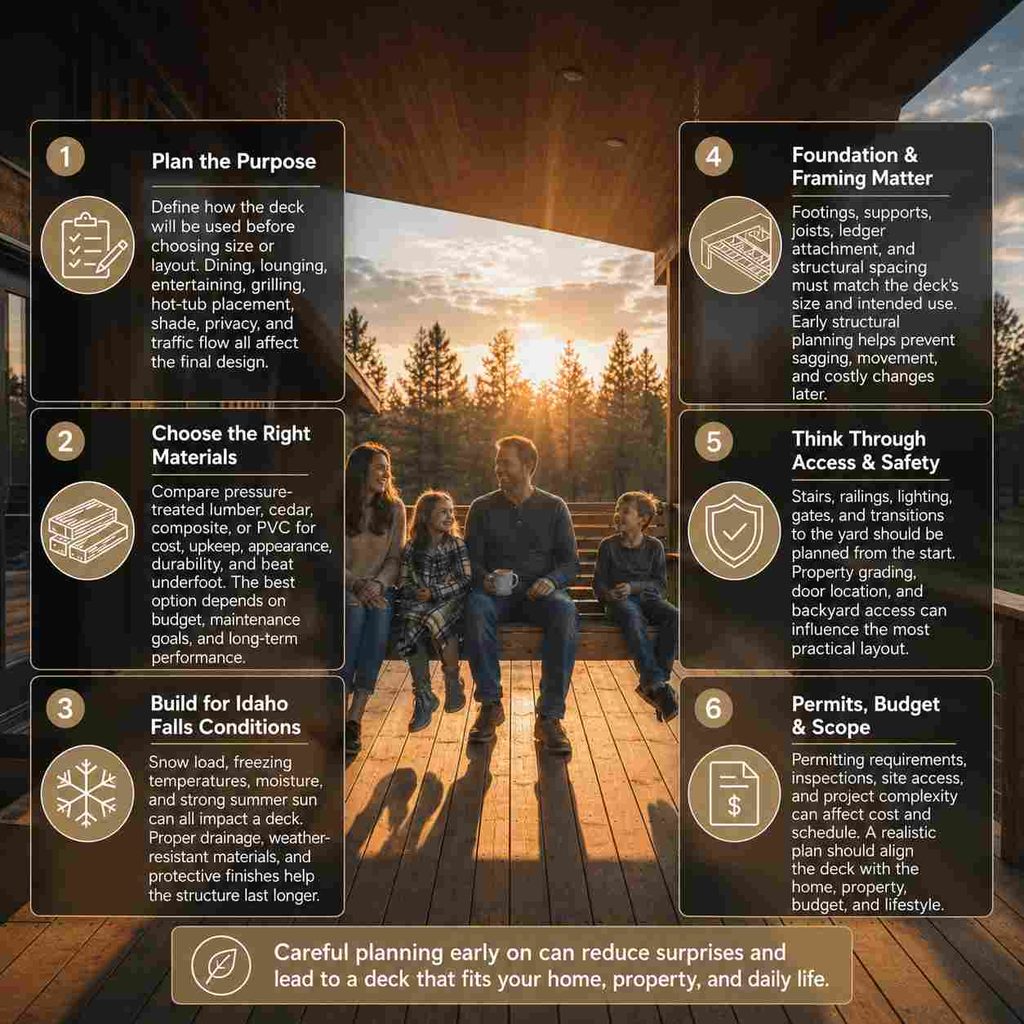
The material, layout, foundation, framing, drainage, stairs, railings, weather exposure, permitting requirements, and intended use all contribute to the final result. Taking time to work through those decisions can help prevent unnecessary changes and unexpected costs later.
For Idaho Falls homeowners, local conditions should be part of that conversation from the beginning. Snow, freezing temperatures, moisture, summer sun, property grading, and access to the yard can all influence the project.
Blue Collar Builders takes a practical approach to construction, helping homeowners understand the decisions involved before work begins. Whether you are planning a simple backyard deck or a larger outdoor living space, the goal is to build something that fits your home, property, budget, and lifestyle.
Ready to Plan Your Deck in Idaho Falls?
If you’re considering a new deck, start with the basics: how you want to use the space, what your property can accommodate, and which materials fit your budget and maintenance expectations.
Blue Collar Builders can help you evaluate your property’s layout, discuss deck materials and design options, and develop a plan around your goals.
Contact Blue Collar Builders to discuss your deck-building project in Idaho Falls and take the next step toward creating a more functional outdoor living space.
Frequently Asked Questions
How much does it cost to build a deck in Idaho Falls?
The cost depends on the deck’s size, height, materials, foundation, stairs, railings, site conditions, and design complexity. A project-specific estimate is more useful than relying on a single average price.
What is the best material for a deck in Idaho?
There is no single best material for every Idaho home. Wood, composite, and other decking products offer different combinations of appearance, maintenance requirements, durability, and upfront cost.
Is composite decking worth the extra cost?
Composite decking can be a good option for homeowners who want a consistent appearance and less routine maintenance than traditional wood. Whether the higher upfront cost is worthwhile depends on your budget, preferences, and long-term plans for the deck.
Do I need a permit to build a deck in Idaho Falls?
Permit requirements depend on the specific project and current local regulations. Factors such as the deck’s height, location, attachment to the home, and structural design can affect what requirements apply, so homeowners should verify current information before construction begins.
How long does it take to build a deck?
The construction timeline depends on the deck’s size, design, materials, site conditions, weather, permitting, and the contractor’s schedule. The complete project timeline may also include design, material ordering, inspections, and other preparation before construction starts.
How long does a deck last?
A deck’s service life depends on its materials, construction quality, weather exposure, drainage, maintenance, and use. Following the manufacturer’s care recommendations and addressing maintenance issues early can help protect the investment.
Is composite decking good for snowy weather?
Composite decking products can perform well in outdoor environments, but products differ and should be installed according to their specific requirements. Consider snow exposure alongside drainage, structural design, installation practices, and applicable building requirements.
Should I choose wood or composite decking?
Wood may appeal to homeowners who prefer a natural appearance and are comfortable with regular maintenance. Composite may be a better fit for homeowners who prioritize lower routine maintenance, so the choice should consider both the upfront investment and long-term expectations.
Can I customize the size and shape of my deck?
Yes. A deck can be designed around the home’s layout, property, intended use, and budget. More complex shapes, multiple levels, stairs, and custom features can increase the planning, materials, and labor required.
What should I ask a deck builder before hiring them?
Ask about experience, insurance, applicable licensing, permits, materials, structural work, project scope, timeline, warranties, references, and cleanup. Most importantly, make sure the proposal clearly explains what is included so you can compare contractors fairly.
Next: Bathroom Renovations